 EXPLORASELF
Resources · Work
Mastering your inner boardroom: who really makes your business decisions?
Hear your Dreamer, Realist and Critic, then make the call with confidence.

A business has a chance to expand into a new market. Around the table sit the marketer, the accountant and the head of quality. The marketer is excited: “This is huge. We have to move now.” The accountant replies: “Marketing needs resources we don’t have.” The head of quality adds: “And it has to be excellent, or we risk our reputation.” Everyone nods. Let’s wait and see. Meeting adjourned.
Every reason was sensible. And yet the business did not grow. The past, the present and the future were fighting each other instead of working together. Here is the uncomfortable part: that meeting does not only happen in companies. It happens inside your head every time you face a decision about money, growth or risk.
The business you build can never be bigger than the person who leads it.
1. Three voices, three time zones
I call it the inner boardroom. Three directors sit on it, and each one lives in a different time.
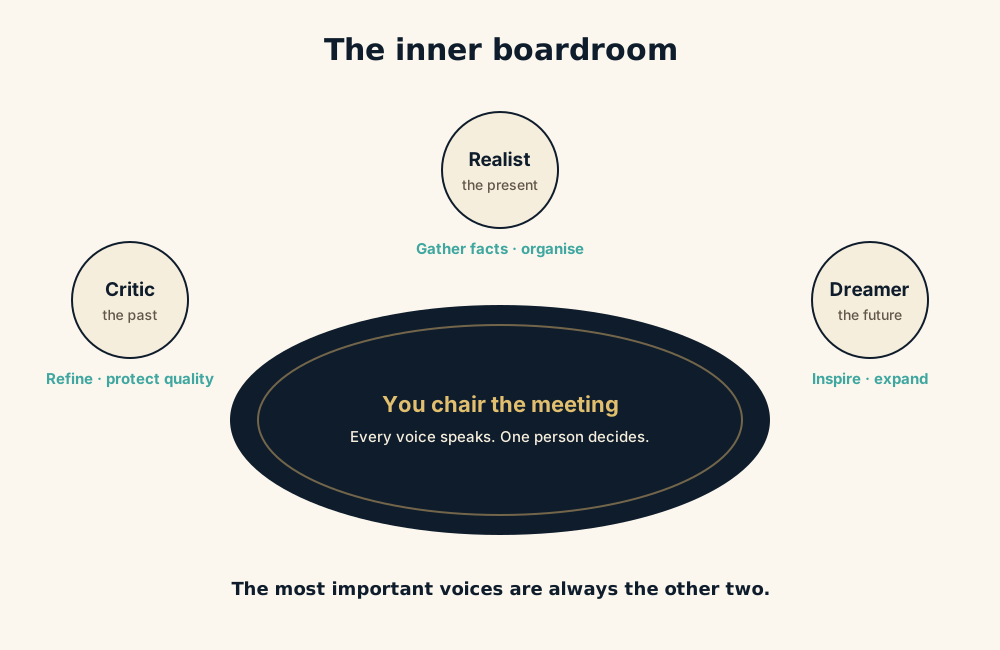
- The Critic lives in the past. It refines, reflects and protects quality. It remembers every mistake.
- The Realist lives in the present. It gathers facts, organises and informs. It wants to know what is true now.
- The Dreamer lives in the future. It inspires, expands and conquers. It sees what does not exist yet.
Try it
Who is talking? Match each sentence to the voice
“Imagine if we had a hundred clients like this one by next year.”
“The last launch flopped. Let’s not go through that again.”
“We have £4,000 and ten hours a week. What fits inside that?”
“It isn’t good enough yet. One more round of changes.”
“Let’s try something completely new this month.”
2. When one voice takes the throne
Each voice is a brilliant adviser and a terrible dictator. When one of them rules alone, the symptoms are easy to see from outside and very hard to see from inside.
Try it
Is one voice running your board? Tick what is true this month
0 of 8. Your board is balanced. Keep chairing it on purpose.
- Critic on the throne: perfectionism, pride, cynicism, no drive, endless study instead of action.
- Realist on the throne: lost in details, extremely cautious, safety always over risk, slow to move.
- Dreamer on the throne: many words and few results, chasing every new idea, routines that never last.
I often ask a room which of the three voices is the most important. Whichever one you choose, the answer for you is the same: the most important are the other two.
3. Chair the meeting
Your role is not to be one of the three. It is to chair the meeting. Before any significant decision, give each voice a turn, in this order:
- Dreamer: what is possible here if it goes well?
- Realist: what do we actually know, and what does it need?
- Critic: what went wrong last time, and how do we prevent it?
- Chair: given all three, what is the next step, and when?
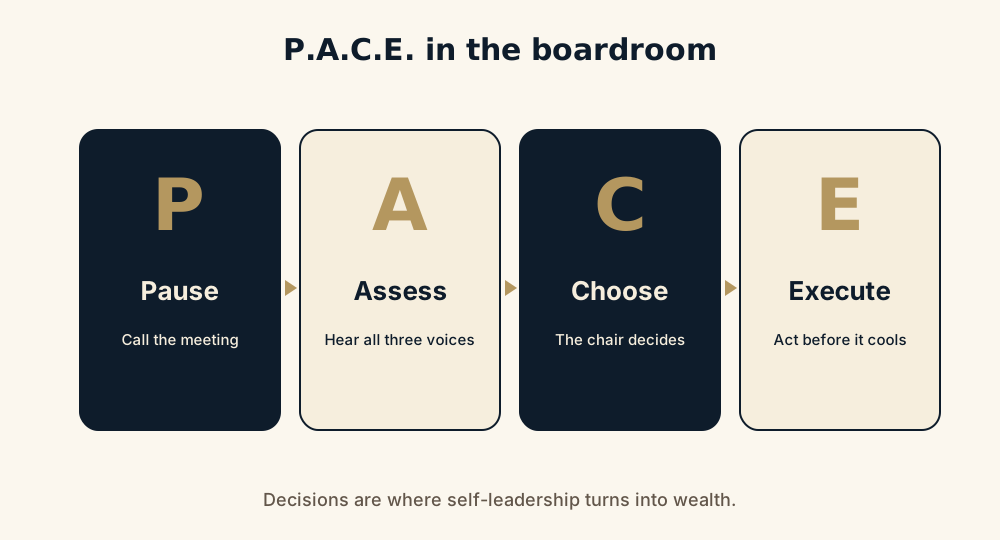
Then close the meeting with a decision. A board that only discusses is not a board. It is a debating club. This is exactly where P.A.C.E. fits.
Quick check · 30 seconds
Where are you stuck right now?
Your to-do list is mostly…
When a big decision arrives, you…
What would change your next 90 days the most?
4. Why this is a money question
Wealth is a leadership result. Who you believe you are shapes what you hold to be true. That shapes how you behave, what you do and, in the end, what you earn.
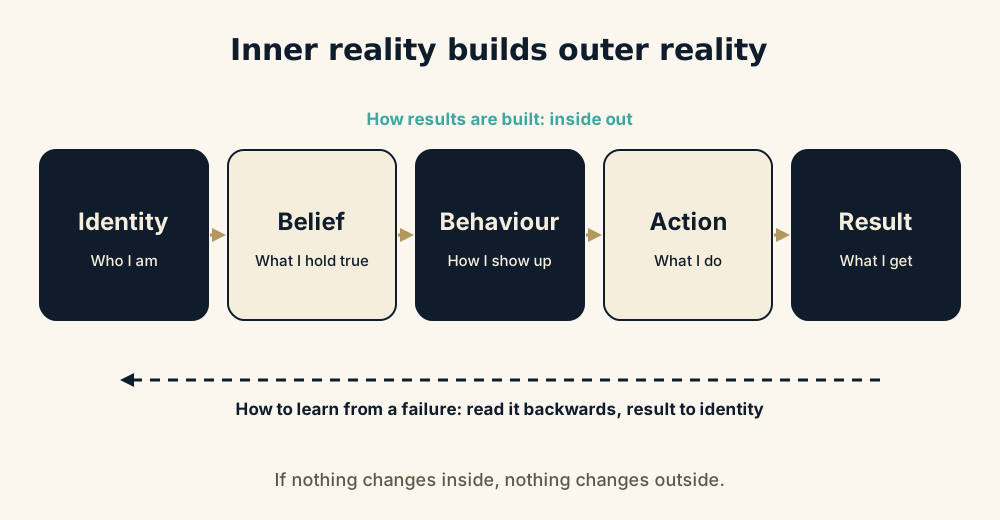
A sale that did not close is rarely about the sale. You did not ask for it. You did not ask because you believed it would sound pushy. You believed that because, somewhere, you see yourself as someone who should not need to sell. Change the belief, and the next result changes with it.
Words are where you can see the boardroom most clearly. The Critic on the throne speaks in “I don’t have, I can’t, I am not”. A chaired board speaks differently.
Try it
Constructive or destructive? Sort these everyday phrases
“I can’t afford it.”
“I’m learning to read my numbers.”
“Sales isn’t for me.”
“That was a lesson I paid for. Let me use it.”
“It’s too late for me.”
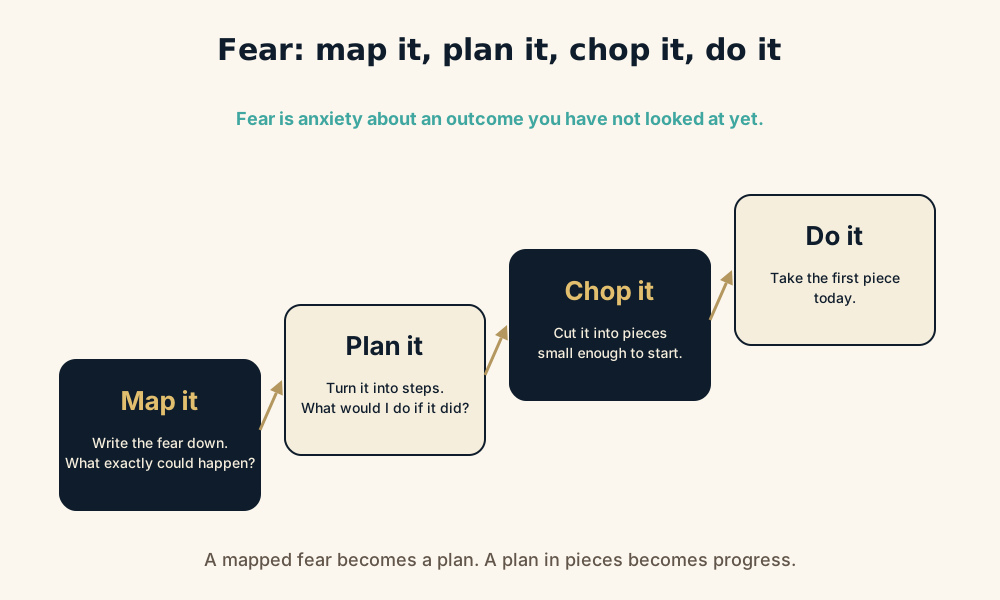
5. Fear: map it, plan it, chop it, do it
Most boardrooms are not ruled by a voice at all. They are ruled by fear in disguise: a slow build-up of conviction that a bad outcome is real and coming. It stays a fog until you put it on the table, where the Realist can measure it and the Critic can help you prepare.
Practise it
Take one fear out of the fog in one minute
- Map it: write the fear in one sentence. What exactly could happen?
- Plan it: if it did happen, what would you do first?
- Chop it: cut the task you are avoiding into one small piece.
- Do it: decide when today you will do that piece.
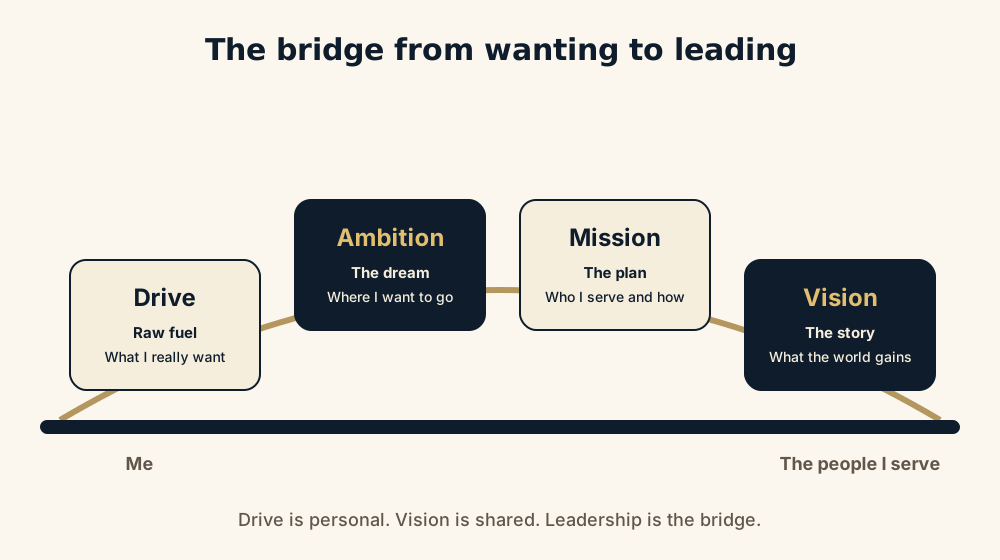
6. From what you want to who you serve
Drive is raw fuel: what you really want, honestly. Ambition gives it a direction. Mission turns it into a plan for other people. Vision is the story of what the world gains. Drive belongs to you. Vision belongs to everyone who joins you. Leadership is the bridge.
Write it
Write your mission in one sentence
I work with … to create … because I believe ….
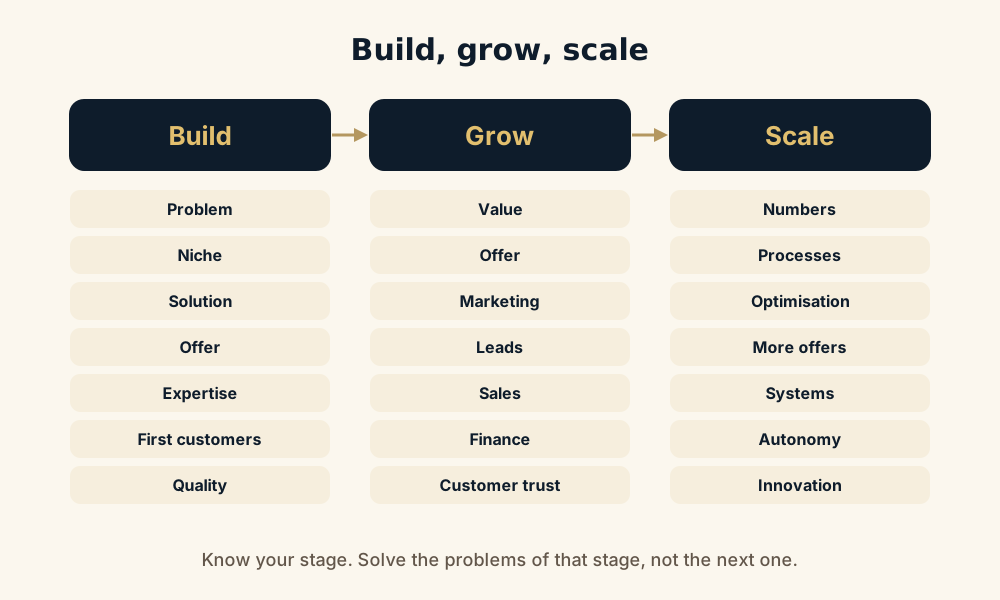
7. Know which stage you are in
Every business moves through three stages, and much frustration comes from solving the next stage’s problems before this one’s are finished. A founder still building who spends weeks on dashboards is hiding from customers. A founder ready to scale who still answers every email personally is blocking the business.
Leader’s questions
- Which voice sits on your throne most often, and which do you silence?
- Which pending decision will you run through the four questions this week?
- What fear is quietly running your business this month?
- Who is the hero of your business story: you, or the client?
Free ebook
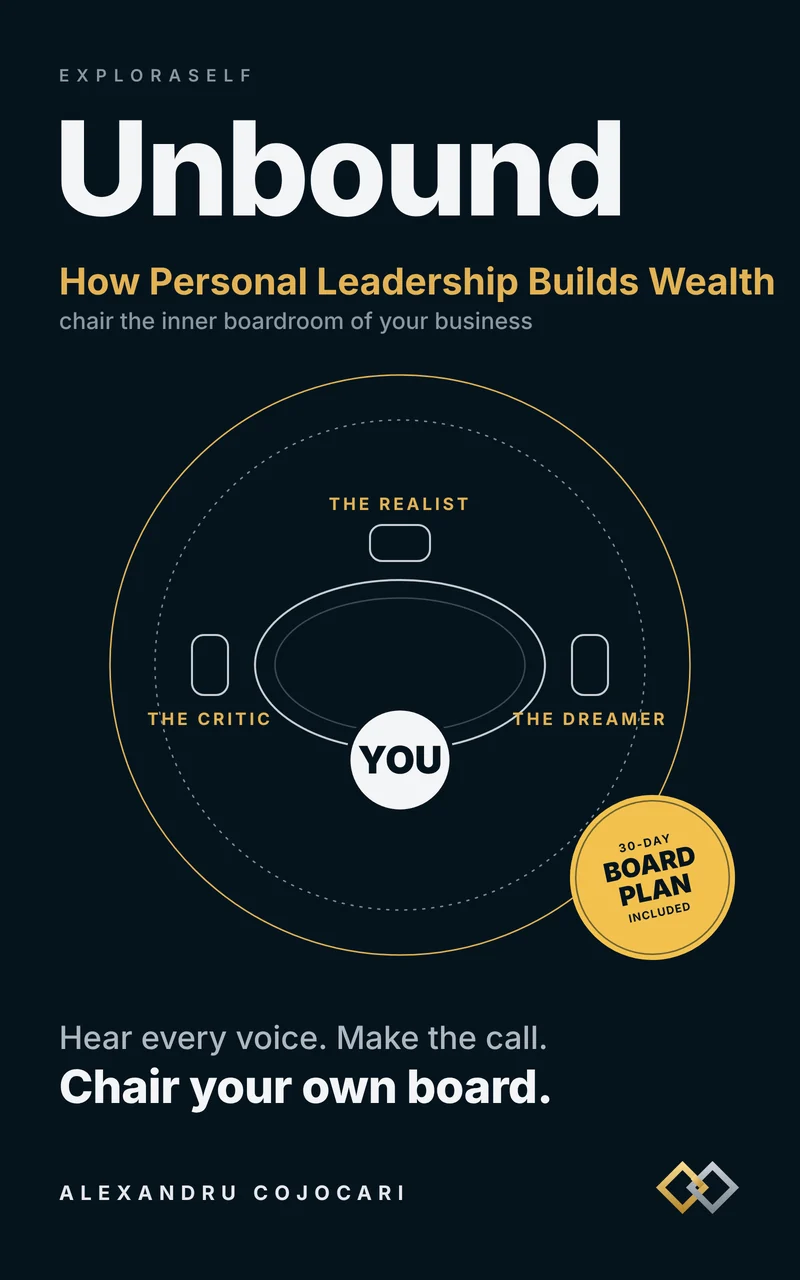
Unbound: How Personal Leadership Builds Wealth
Wealth is not a lucky break and it is not a secret formula. It is what self-leadership leaves behind over time: clear decisions, made by someone who listens to every voice inside them and then acts. Your Dreamer will keep seeing. Your Realist will keep counting. Your Critic will keep remembering. You chair the meeting.