 EXPLORASELF
Resources · Self
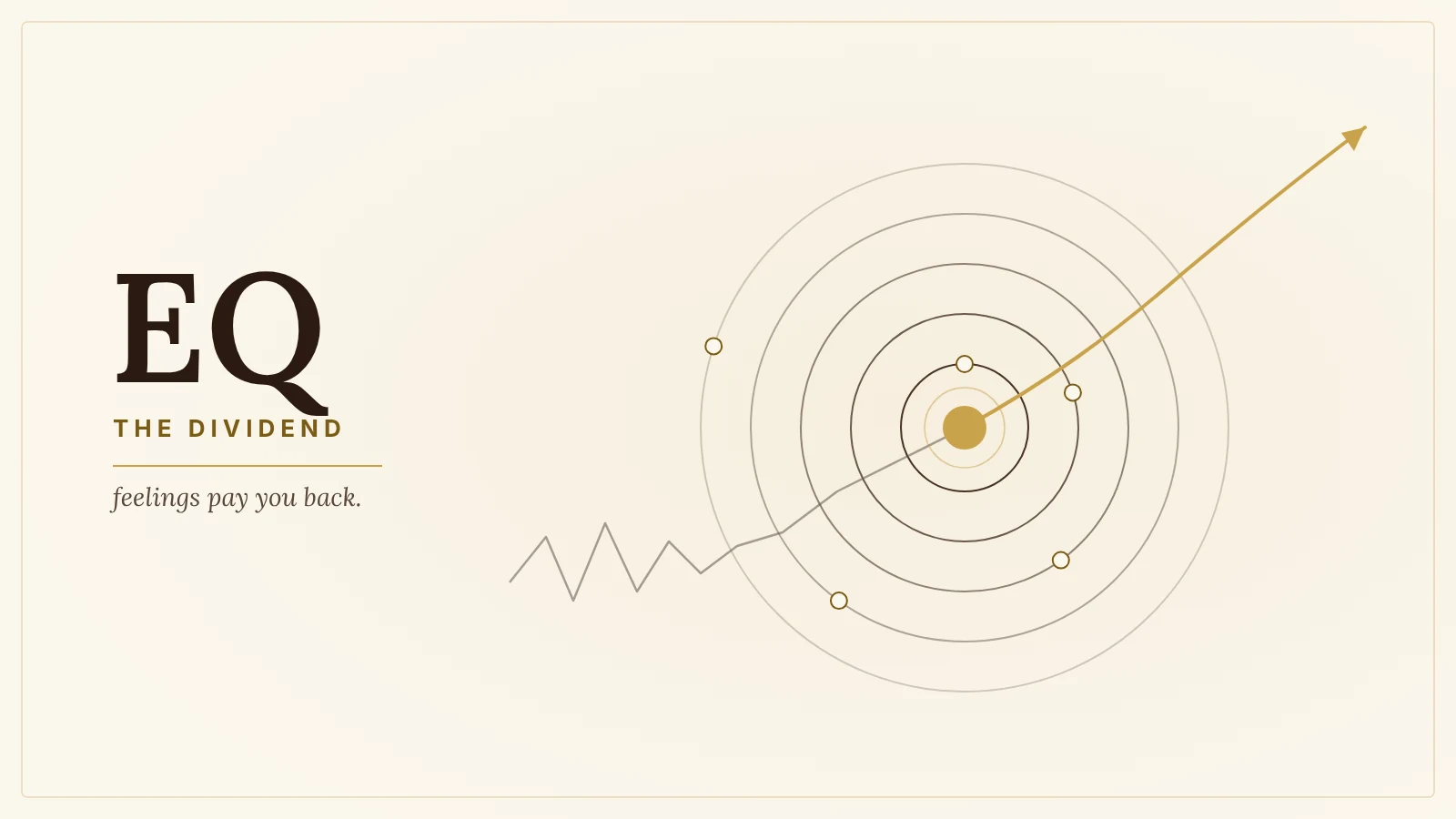
The EQ dividend: how emotional intelligence pays founders back
Five skills that turn feelings into better deals, stronger teams and a calmer life.
When founders come to me, they rarely say “I need emotional intelligence.” They say: sales are flat, my best person just resigned, my co-founder and I aren't speaking, I can't switch off at night. They describe a business problem. Underneath, nine times out of ten, there is an emotional one.
A deal lost because you pushed when the client needed time. A firing delayed for three months because you were afraid of the conversation. A team that tells you everything is green until the month it's red. None of these appear in your accounts as “emotions”. They appear as lost revenue, turnover and wasted months.
You can't see an emotion in your accounts. You can see everything it causes.
1. The numbers behind the soft skill
Emotional intelligence was named by the psychologists Peter Salovey and John Mayer in 1990, and Daniel Goleman brought it into business in the mid-1990s. Since then, organisations have measured what it is worth. In Goleman's analysis of competency models, about two-thirds of the difference between star performers and average ones came from emotional competence, not technical skill or IQ. In top leadership roles, more than four-fifths.
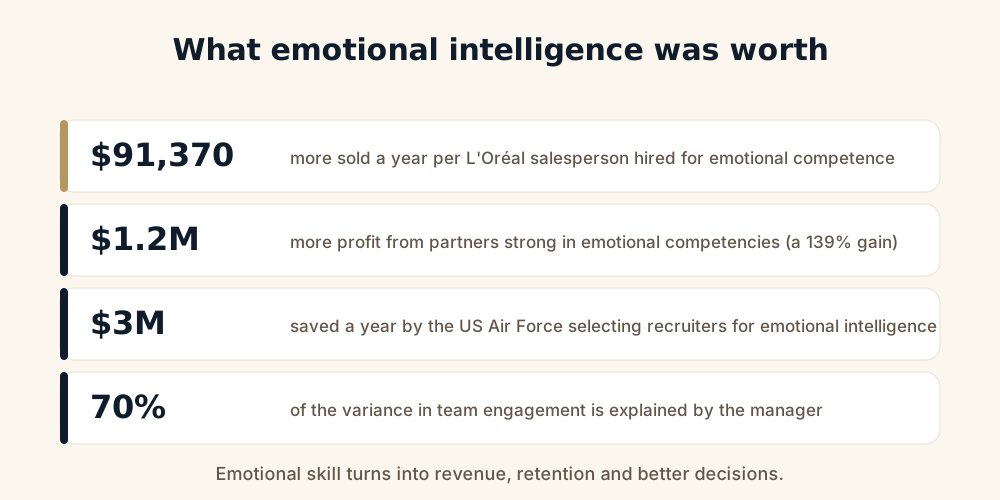
The pattern is the same everywhere: emotional skill turns into revenue, retention and better decisions. And unlike IQ, it can be trained. That's why I call it a dividend. It isn't a personality trait you either have or don't. It's an investment that pays back, and compounds: one calm conversation makes the next one easier; one honest piece of feedback makes the next one arrive sooner.
Try it
Where are your feelings on the balance sheet? Tick what happened this quarter
0 of 6. Your emotional accounts are in good order. Keep investing, and teach what works to the people you lead.
2. The five EQ dividends
I group emotional intelligence into five skills, building on Goleman's five components. Two face inwards and lead you. One is the fuel. Two face outwards and lead others. Each one pays a different return.
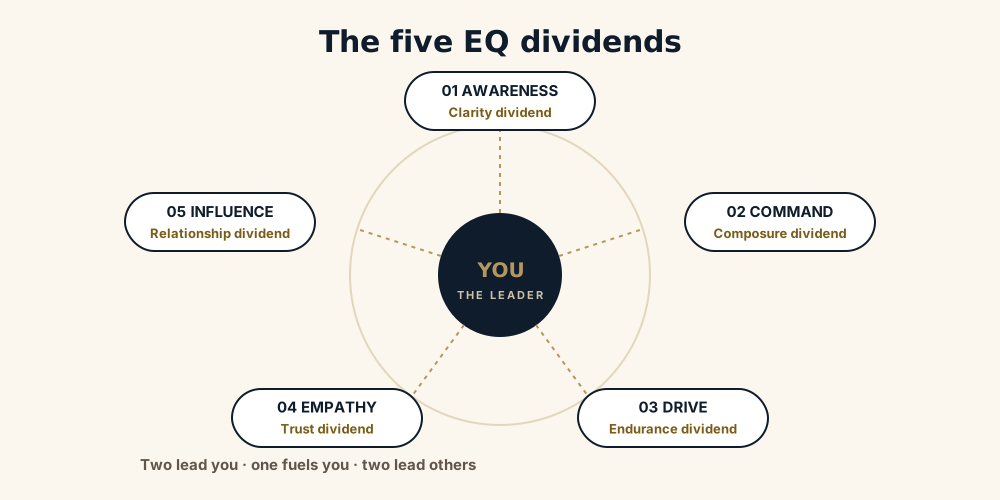
- Awareness, the clarity dividend: noticing and naming what you feel, and why. It pays in decisions made on facts, not moods.
- Command, the composure dividend: choosing your response when a feeling is strong. It pays in fewer reactions you have to repair.
- Drive, the endurance dividend: motivating yourself from the inside. It pays in consistency on the days you'd rather quit.
- Empathy, the trust dividend: understanding what others feel and need. It pays in clients who stay and teams who speak up.
- Influence, the relationship dividend: setting the tone and having hard conversations well. It pays in loyalty and agreement that lasts.
3. Awareness: ask what, not why
Most founders are brilliant at reading a market and poor at reading themselves. Tasha Eurich's research suggests that around 95% of people believe they're self-aware, yet only 10 to 15% actually are. One of her most useful findings: people who ask “why do I feel like this?” often learn less, because the mind is very good at inventing flattering stories. “What am I feeling, and what's happening?” keeps you curious, and gives you something to act on.
Naming helps in a second way. In 2007 a UCLA team led by Matthew Lieberman found that simply putting a label on an emotion (“angry”, “afraid”) reduced activity in the amygdala, the brain's alarm system. The catch is that “stressed” and “fine” are not names. They're fog.
Practise it
A one-minute check-in
- Stop. Notice what you feel right now, in your body first.
- Name it in one precise word: uneasy, irritated, proud, let down.
- Rate it from 1 to 10. Above a 7, make no big decision for an hour.
- Ask what it needs: anger protects, fear prepares, shame repairs, sadness lets go.
4. Command: the leader who clapped
When Alan Mulally became CEO of Ford in 2006, the company was heading for a loss of $12.7 billion, yet every project in his weekly review was marked green. When one executive, Mark Fields, finally showed a red, the room expected him to be finished. Mulally clapped, and asked who could help. The next week the charts were honest, and the real work began.
That clap was command. The frustration was surely real. He chose the response that got him the outcome he wanted: the truth. Psychologists Jennifer Lerner and Dacher Keltner found that angry people judge risks as smaller and make riskier choices; fear does the opposite. Either way, the emotion decides for you unless you build a gap between the trigger and the response.
In that gap, ask one question: will what I'm about to do bring me closer to the outcome I want? The full method for anger, the A.N.G.E.R. reset, is in the free workbook below.
Quick check · 30 seconds
Where are you stuck right now?
When you finally get a free hour, what usually happens?
What wears you out most at the moment?
What would change your next 90 days the most?
5. Drive: when the goal dies, find a bigger reason
In 1915 Ernest Shackleton's ship Endurance was crushed by the Antarctic ice. Their goal, crossing the continent, was gone. Shackleton changed the mission in one sentence, bring every man home, and then led the emotional life of the expedition as carefully as the supplies: routines, small celebrations, the most negative men kept close in his own tent. By August 1916 every one of his men had been rescued.
Motivation is a feeling. Drive is a decision you've made in advance. It runs on three things: a why bigger than money, a minimum for bad days and a maximum for good ones, and energy you protect like cash, because a tired founder has no command, no empathy and very little influence.
Write it
Climb your purpose ladder
When I …, …, so that …. That's why I'm doing it today.
6. Empathy: understand before you lead
When Satya Nadella became CEO of Microsoft in 2014, he set out to replace a know-it-all culture with a learn-it-all one, and put empathy at the centre of it. In his book Hit Refresh he traces that to his son Zain, born with severe cerebral palsy, and to learning to see the world through other people's eyes. At Microsoft it became a strategy: understand customers' unmet needs better than anyone, and build for that.
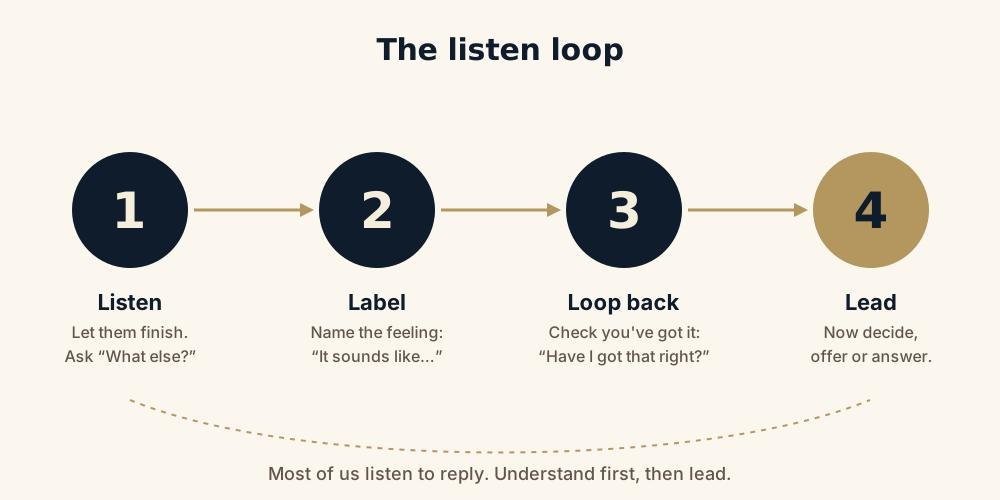
Empathy has a hard edge that's often missed. Understanding someone doesn't mean giving them what they want. A founder with real empathy can say no to a client and keep the relationship, because the client feels heard. Most of us listen to reply. The listen loop changes the order.
Try it
Listening or replying? Sort each response
“That's not a problem, our product handles it.”
“It sounds like you've been burned by this before. What happened?”
“So the real issue is the deadline, not the budget. Have I got that right?”
“I know exactly what you mean. The same thing happened to me.”
7. Influence: your emotions are contagious
In 2002 Sigal Barsade of Yale placed a trained actor in teams negotiating how to share out a bonus. The actor's mood, cheerful or irritable, spread through the group. Where it was positive, teams cooperated more and had less conflict. If an actor with no authority can do that, imagine what the founder does. Your tone in the Monday meeting sets the weather for everyone.
Google found the same thing from another angle. Its Project Aristotle studied 180 teams and found that the strongest factor in great teams was psychological safety: the belief that you can admit a mistake or ask a naive question without being punished. Safety isn't built with a policy. It's built in small moments: how you react to disagreement, whether you admit your own mistakes, whether the hard conversation happens early and kindly.
- The fact: one sentence nobody could dispute.
- The impact: what it does to the business, not to your mood.
- The question: “Help me understand what happened.” Then listen.
- The agreement: what changes next time, and when you'll check.
8. The dividend at home
You didn't start a business to be rich and lonely. The Harvard Study of Adult Development has followed the same people since 1938, and its director, Robert Waldinger, sums up its main finding simply: good relationships keep us happier and healthier. The same five skills that grow your company protect the life it's meant to pay for. The best return on emotional intelligence isn't on your P&L. It's the evening you're actually present for.
Free ebook
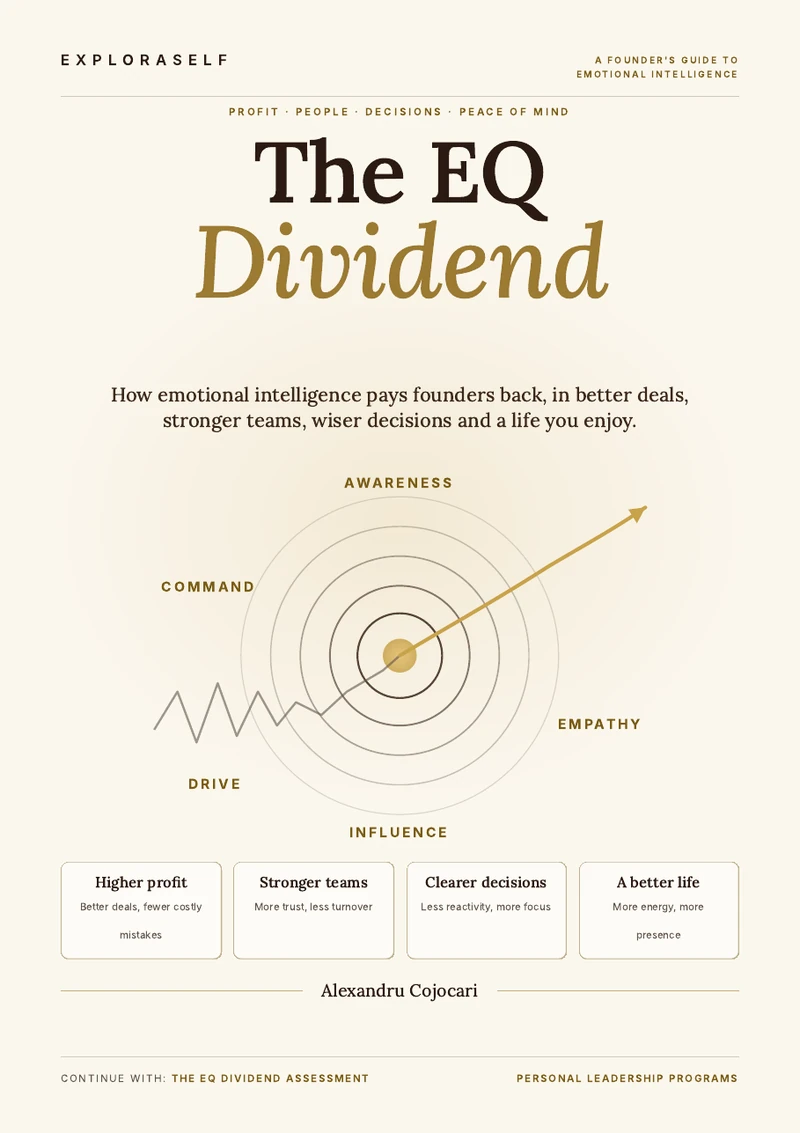
The EQ Dividend: How Emotional Intelligence Pays Founders Back
Emotional intelligence isn't soft. It's the skill behind every deal you close, every person who stays and every evening you get back. Find the dividend that's leaking, invest a few minutes a day, and watch what it pays.