 EXPLORASELF
Resources · Self
Lead from the tower: why focus is the first skill of leadership
Get your focus back, protect your energy, and lead from calm.
Why do some people stay calm and productive in the middle of an intense life, while others with fewer demands are crushed by tasks, wishes and plans that never leave the page? I watched this for years, first as a trainer of athletes, then as a mentor to founders. The ones who won were not always the most talented. They were the most focused.
Without focus you are a ping-pong ball. Every time you touch a hard surface you bounce again, in a direction nobody can predict, least of all you. And because people follow a leader’s attention, a scattered leader produces a scattered team.
You are not distracted because of the distraction. You are distracted because of a lack of focus.
1. Your focus runs on a limited reservoir
Everything you do costs energy: reading, talking, deciding, even postponing. Thinking about a task, preparing it, putting it off and coming back to it costs more than doing it once. Your energy is a reservoir, not a river.
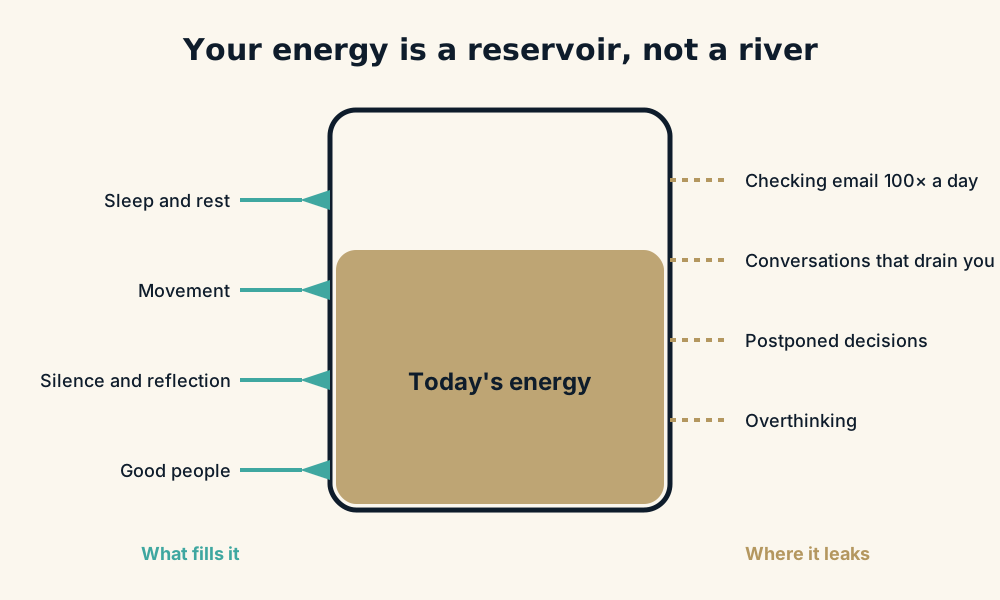
Try it
Find your leaks: tick everything that happened this week
0 of 6. A well-guarded reservoir. Protect what is working and keep the gates closed.
2. Your mind holds a meeting before every decision
The biggest battle in your head is between thinking and feeling. Habit and emotion are fast and old. Planning and judgement are slow and new. Picture both halves sitting at a table in front of you, each insisting it is right. You are the chair. Your job is not to silence either side, but to agree the rules of trade between them and then decide.
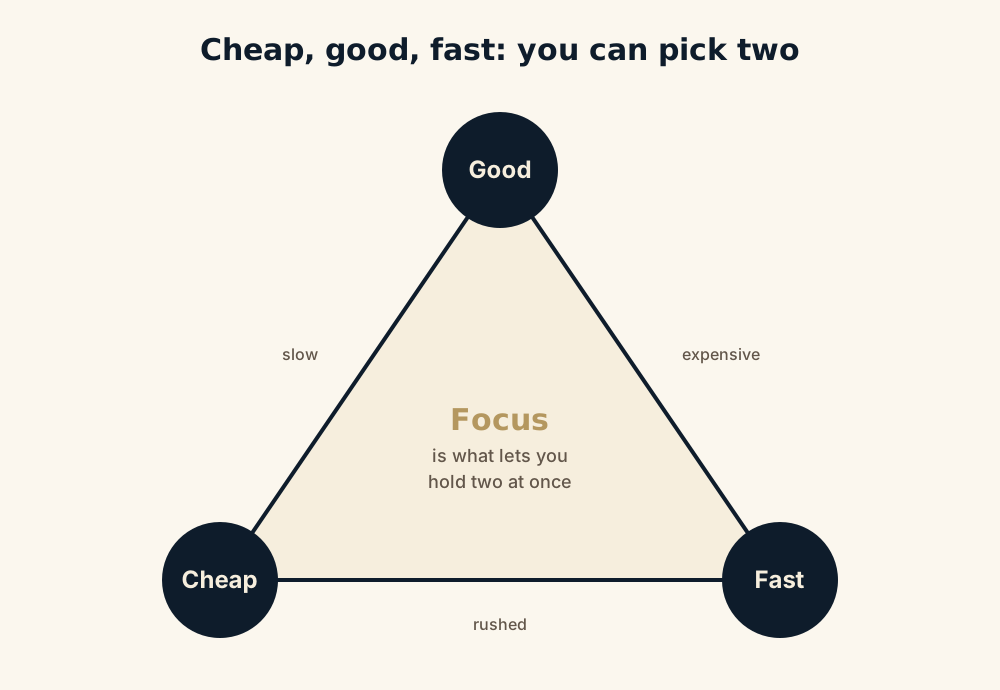
Two practical rules help the chair. First, give your brain a clear order of priorities: if every task sits on the same level, your mind will be confused, and confusion looks like a lack of focus. Second, stop believing in multitasking. Most people can juggle five tasks for months and produce average work on all of them. Learn to focus on one thing, then switch between tasks at a rhythm you choose.
3. Look down at the step, look up at the road
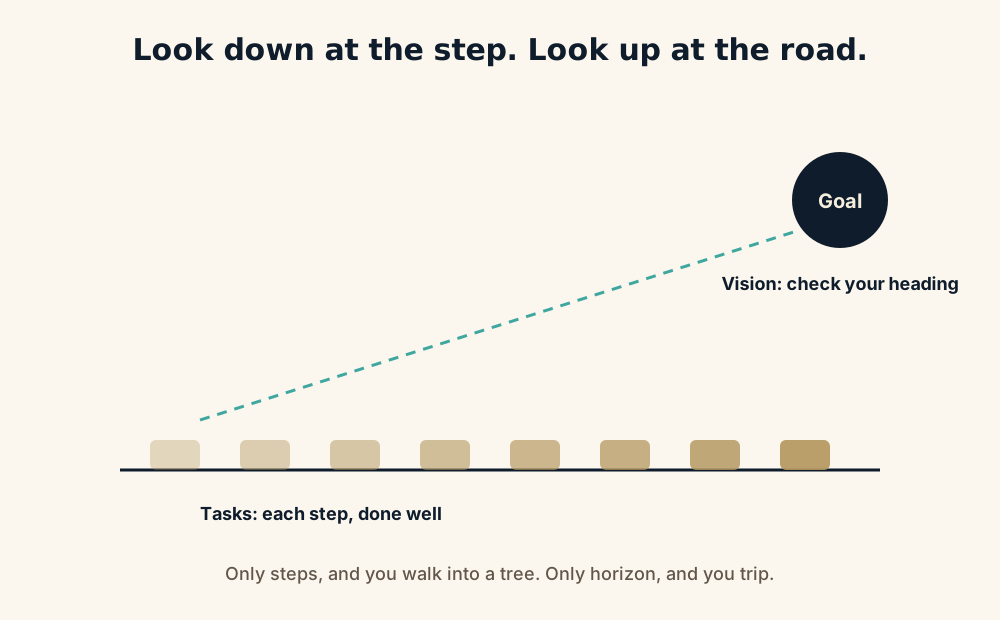
Leaders need two kinds of focus at once: on the task in front of them and on the direction of the whole journey. A goal is a point of comparison between where you are and why you are going. Teams that see only tasks lose meaning. Teams that see only vision lose momentum.
Quick check · 30 seconds
Where are you stuck right now?
When you finally get a free hour, what usually happens?
What wears you out most at the moment?
What would change your next 90 days the most?
4. Important or urgent?
A distraction is anything that, in that moment, has more power over you than your desire to finish what you started. Urgency creates focus, which is why deadlines work. Leaders create that clarity before the deadline does it for them. The ark was built before the rain.
Try it
Try it: where does each task belong?
A key client is unhappy and has asked for a call today.
Writing next quarter’s priorities with your team.
Formatting the slides for the weekly update.
Scrolling a competitor’s social feed ‘for research’.
Before your next important task, ask four questions: How long will I give this? What might interrupt me, and is it more important? What distracted me last time? Is my environment helping or hurting? Setting your mind before the work makes you surprisingly resistant to distraction during it.
5. The fortress and the tower
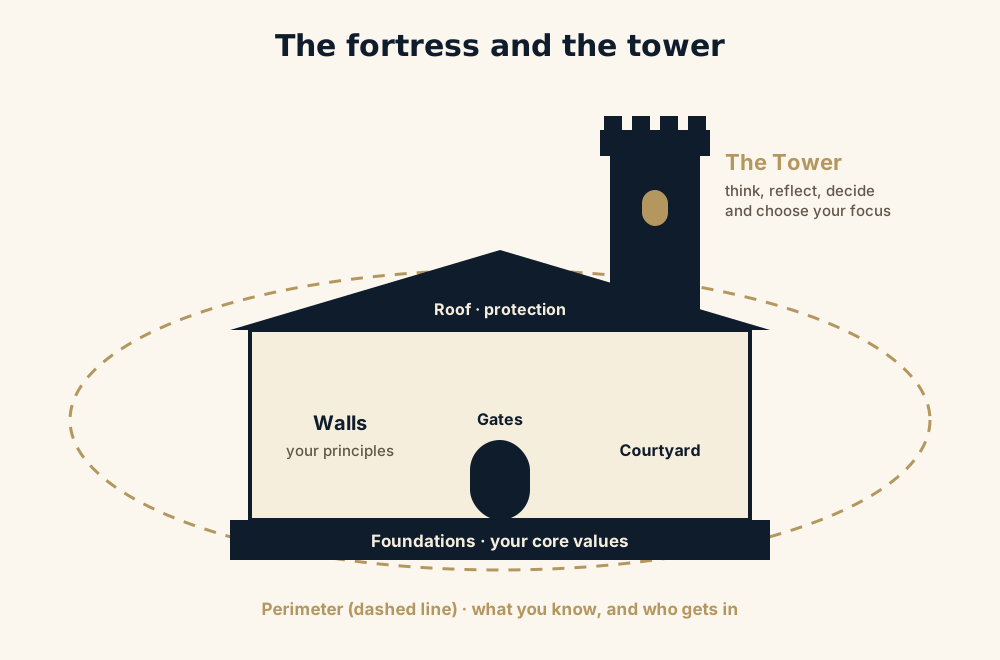
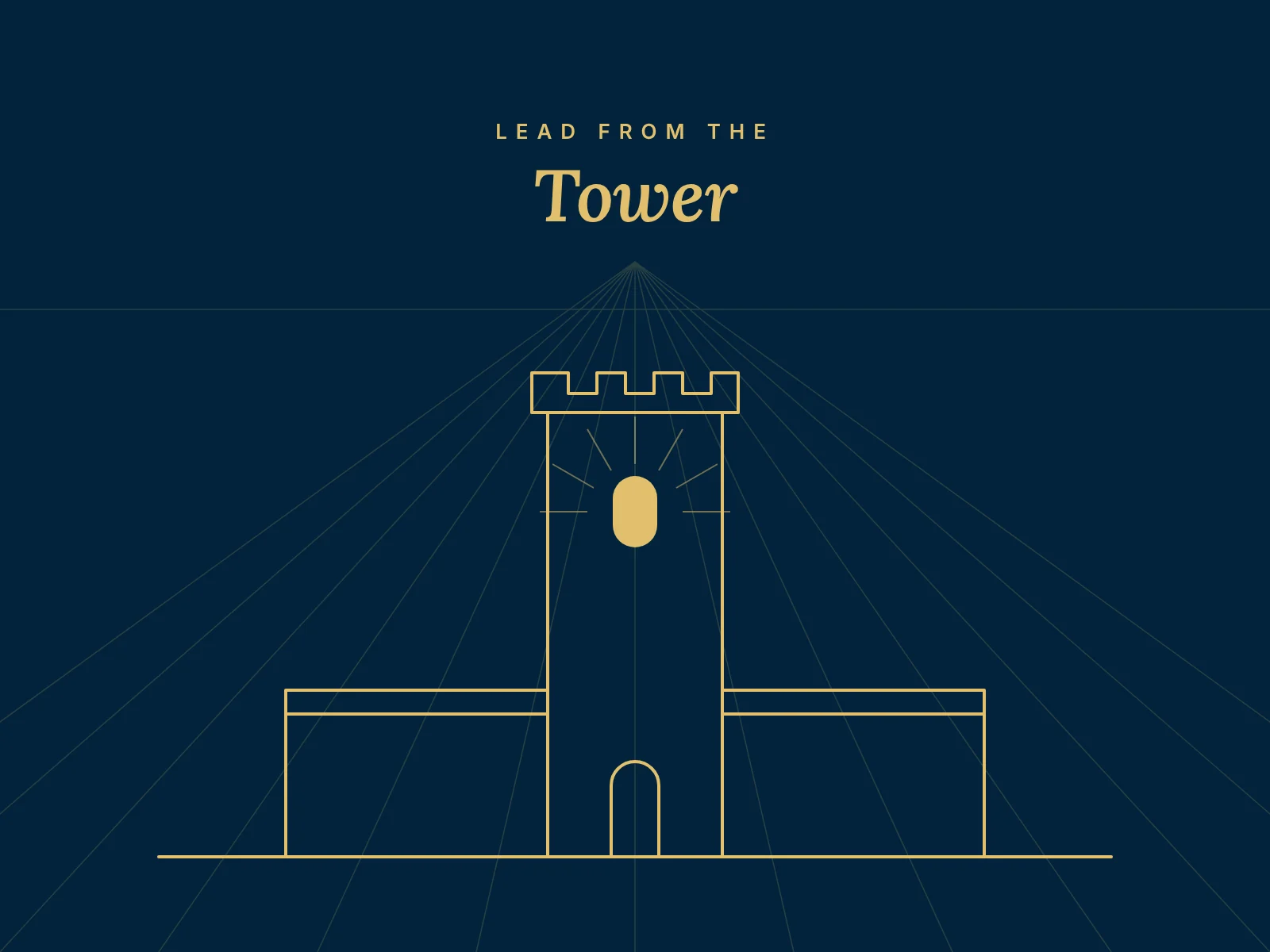
I picture a mature leader as a fortress. The foundations are your core values. The walls are your principles. The roof protects you from toxic people and hard seasons. The gates decide who and what gets in. And the tower is where you go alone: where your calm lives, where you see clearly, and where you decide where your focus goes.
Go to the tower every day. At least fifteen minutes with no people, no tasks and no input. Without it, it is very easy to lose touch with what matters and drown in small details.
Practise it
One minute in the tower
- Put your phone face down.
- Breathe slowly and notice what is pulling at your attention.
- Ask: what is the one thing that matters most today?
- Decide the first step, and when you will take it.
6. P.A.C.E. from the tower
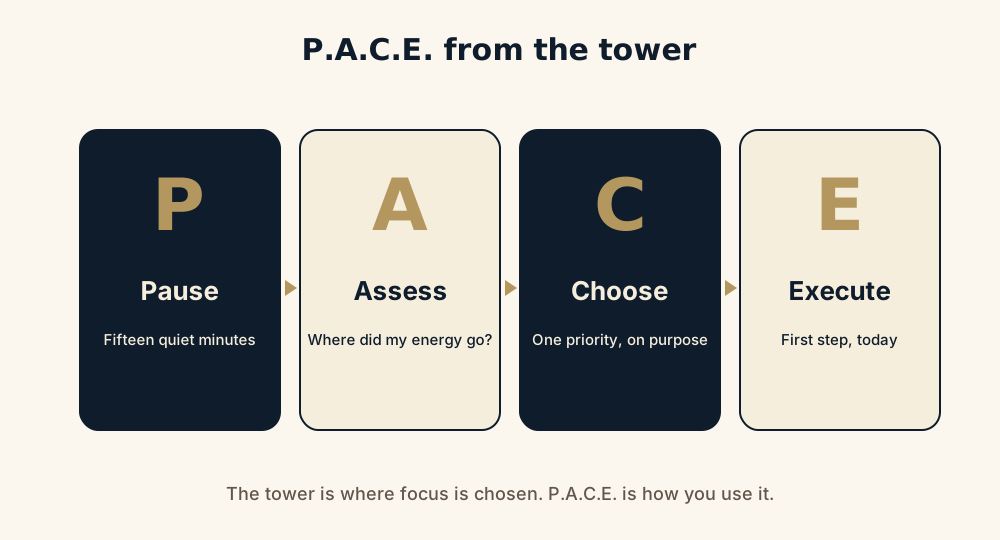
- Pause: fifteen quiet minutes. Create a beat between what happens and how you respond.
- Assess: where did my energy go yesterday, and what truly matters today?
- Choose: one priority, on purpose, and a clear no to what competes with it.
- Execute: take the first step today. Focus is not a feeling. It is a decision repeated.
Focus will not make your life free of problems. It will make you someone problems cannot scatter. Your team will feel the difference first.