 EXPLORASELF
Resources · Business
Win your first 100 perfect clients with better conversations
Fix the three conversations that make people find you, trust you and buy.

Picture two founders at the same networking event. Both are good at what they do. Both have spent months on a beautiful website. One of them leaves with three real conversations and a calendar invite. The other leaves with a pocket of business cards and a vague plan to “post more”.
The difference was not talent, budget or luck. The first founder could say, in one breath, who she helps, with what, and why it matters. The second one said, “It depends on the person.” That sentence has cost more clients than any bad advert ever will.
Become or offer the perfect solution to a perfect problem that 100 people in your niche have.
1. Read the title slowly
“Get your first 100 perfect clients for your niche” looks like a promise. It is actually a set of instructions, and each word does a job.
- 100: not a million followers. A hundred people who pay. It is small enough to know them and big enough to build a business on.
- Perfect: the ones who value what you do, pay what it is worth and get the result. Imperfect clients cost you energy, margin and belief.
- Clients: someone who exchanges value, not someone who clicks, likes or “might be interested”.
- Niche: one problem, for one kind of person, in one market. The narrower the door, the easier it is to walk through.
Try it
Want or need? Sort what founders say when they ask for help
“I want a better website.”
“People should understand what I do in five seconds.”
“I want to go viral.”
“I need one clear problem for one kind of person.”
“I want more followers.”
2. Three conversations, one result
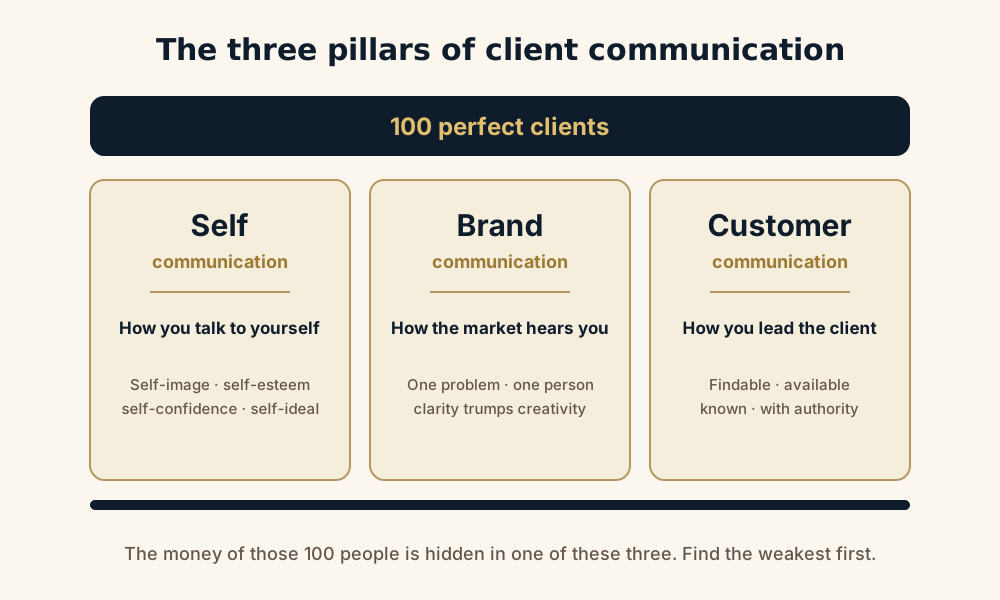
Most founders try to solve this with more marketing. But clients appear when three conversations are healthy, in this order: the one with yourself, the one with the market, and the one with the client in front of you. If one is weak, the other two cannot carry it.
3. Self communication: the first filter
Before the market believes you, you have to. Four things show up in your voice, your price and the clients you accept: your self-image (what you see), your self-esteem (what you feel), your self-confidence (what you do) and your self-ideal (who you become).
One sentence from my own work changed how I coach this. “I’m not capable” closes the door. “I’m not capable yet, but I’m able to become capable” opens it. The first is a verdict. The second is a plan.
Try it
Is your inner voice costing you clients? Tick what is true this month
0 of 6. Your inner conversation is steady. Keep your price calm and your standards clear.
Practise it
One minute: say your price like you mean it
- Stand up and breathe out slowly. Let your shoulders drop.
- Say your price out loud, once, without explaining it.
- Stay silent for three full seconds. Notice the urge to fill them.
- Say it again, slower. Write down the result you have created for someone.
Quick check · 30 seconds
Where are you stuck right now?
Where do your new clients come from today?
When someone asks your price, you…
What would change your next 90 days the most?
4. Brand communication: how the market hears you
A stranger should be able to look at your offer and see themselves already on the other side of their problem. That is all marketing is for. It has to make them feel inclined to buy, think differently, decide, and choose you. And here is the rule I repeat the most: clarity trumps creativity.
The mistakes come in a predictable order. Experts are not findable, so nobody sees them. Or they are findable but not available, so nobody can buy. Or they are available but not known, so nobody trusts them. Or they are known but lack authority, so nobody pays full price.
A simple sentence fixes most of it. Fill in the blanks below, then read it to someone who is not in your field. If they can repeat it back, it works.
Write it
Write your offer in one sentence
Discover how to … so you can …, without ….
5. Customer communication: lead, don’t just sell
You are not in the sales business. You are in the life-changing business. A lead only becomes a client when value is exchanged, and for anything above a small price that happens in a real conversation. Weak conversations waste every lead you worked to earn.
Your client is the hero of the story, not you. You are the guide who has walked the path before. That changes your language in small, powerful ways: from “I will do it” to “we will do it”, and from explaining your method to describing who the client will become.
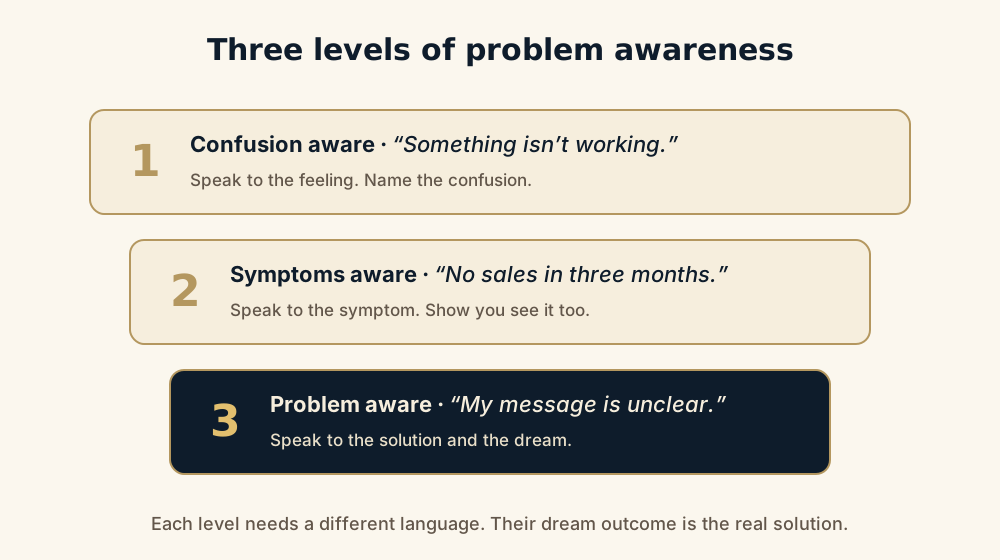
It also means speaking to the awareness your client actually has. A person who is confused needs a different sentence from one who knows the problem by name.
Try it
Which level is this person at?
“I’m exhausted and I don’t even know why.”
“I get plenty of enquiries, but nobody buys.”
“My positioning is unclear. I need a message that sells.”
“Something feels off in my business lately.”
6. Where you are decides what to do next
Every founder is in one of three phases, and each needs different work.
- Starting out: you are testing ideas and have no steady clients yet. Choose one problem and one person, and talk to ten of them before you build anything else.
- First clients: you have your first clients and need a message and a way to win more. Pick one offer, one message, one channel, and repeat them until they work.
- Growing: clients arrive and you want to lead them, and a team, to bigger results. Move from doing everything yourself to leading: write down how you win and serve clients, then hand one task over each week.
7. Your seven days
You do not need a new strategy this week. You need one conversation fixed. Choose the weakest of the three, give it fifteen minutes a day, and finish each day with one action another person can see.
Leader’s questions
- Which of the three conversations did you tick the most boxes for today?
- Who is the one person you could describe in detail, and what do they say about their problem?
- What would you say if you could not explain, apologise or hedge?
- Who is the hero of your story: you, or the client?
A hundred clients do not arrive all at once. They arrive one at a time, after one conversation that went well. Your next client is not waiting for a better website. They are waiting for you to say, clearly and calmly, that you can help.